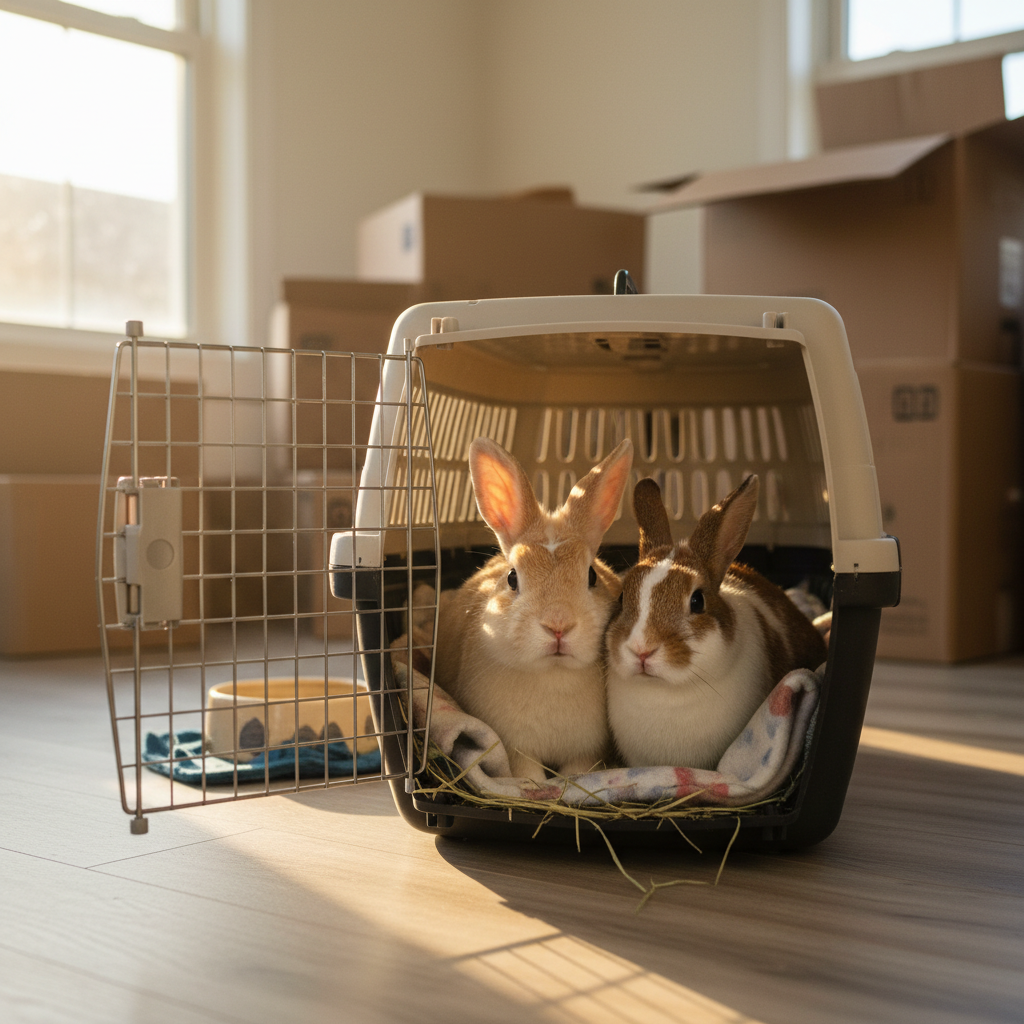

How to Move to a New Home with a Bonded Pair of Rabbits (Without Breaking the Bond)
Relocating with a bonded pair of rabbits is the process of moving two rabbits who share a deep social connection to a new environment while prioritizing the preservation of their social hierarchy and emotional stability. Because rabbits are prey animals that rely heavily on environmental familiarity and social support, domestic moves represent a significant stressor that can, in extreme cases, lead to a 'bond break' or territorial fighting. Successful relocation depends on maintaining the pair's proximity, minimizing scent disruption, and monitoring health indicators like appetite and fecal output during the first twenty-four hours in a new home.
The Psychology of Bonded Rabbits During Travel
To understand why day one is so critical, one must understand the nature of the rabbit bond. In the wild, rabbits live in complex social groups where safety is found in numbers. When a pair is bonded in a domestic setting, they view each other as their primary source of security. During a move, their world-defined by familiar smells and hiding spots-disappears. This leaves the other rabbit as the only remaining 'constant' in their lives.
Many owners worry that the stress of travel will cause rabbits to turn on one another. While 'referred aggression' can occur-where one rabbit blames the other for a scary noise or vibration-most bonded pairs actually lean on each other for comfort. Research into lagomorph behavior suggests that social housing significantly reduces cortisol levels during environmental transitions. This is why the golden rule of relocating bonded rabbits is to never separate them. Even a short separation during a vet visit or a car ride can cause 'forgotten' scents, leading to territorial disputes when they are reunited.
On day one, your goal is to be the guardian of this bond. You are not just moving two animals; you are moving a single social unit. Any disruption to their ability to see, smell, or groom each other can jeopardize their lifelong partnership.
Preparing the Day-One Enclosure
The first mistake many owners make is giving their rabbits too much space too soon. In a new home, a vast, unfamiliar territory can be overwhelming. It can also trigger a 'territorial reset' where one rabbit decides to claim the new living room as their own, excluding their partner.
Imagine setting up a small, neutral pen rather than giving them free-roam access immediately. This 'Base Camp' should be established before the rabbits even arrive at the new property if possible. Use an exercise pen (x-pen) rather than a cage to allow for adequate airflow and enough space for two litter boxes, but keep the total square footage modest-roughly 16 to 24 square feet.
The Importance of Familiar Scents
Wash nothing. This is contrary to most human moving instincts, but for a rabbit, a 'clean' house is a 'scary' house. On day one, the enclosure should be filled with unwashed blankets, familiar hidey-holes, and their used litter boxes from the previous home. The scent of their own hormones and pheromones acts as a chemical anchor, telling their nervous systems that this new space is actually a safe extension of the old one.
Neutral Ground Strategy
If your rabbits have a history of minor squabbles or if the bond is relatively new (less than a year), day one should take place in a neutral room where they have never been. This prevents 'pre-established' dominance. By placing them in a neutral space together, they are forced to rely on each other for comfort, which can actually strengthen a bond during the stress of a move.
The First Hour: Arrival and Observation
When you first walk through the door of your new home, the temptation is to let the rabbits out to explore. Resist this. Instead, place the carrier inside the pre-set 'Base Camp' and open the door. Let them emerge at their own pace. Some pairs will bolt out together; others may hide in the carrier for hours. Both reactions are normal.
During this first hour, your primary job is observation without interference. You are looking for 'The Big Three' of rabbit health:
- Movement: Are they frozen in place for more than an hour, or are they beginning to twitch their noses and explore the immediate perimeter?
- Grooming: Is one rabbit grooming the other? This is the ultimate sign of a stable bond. If they are grooming themselves, it shows they are beginning to relax.
- Appetite: This is the most critical metric. A rabbit that does not eat for twelve hours is at risk of GI stasis, a life-threatening condition.
Nutrition and Hydration Management on Day One
Stress causes the digestive tract of a rabbit to slow down. On day one of a move, hay is your best friend. While you might be tempted to give them extra treats to 'apologize' for the move, sugary fruits or heavy pellets can upset a stressed gut.
Water Source Consistency
Water in different geographic locations tastes different due to mineral content and chlorination levels. Many rabbits are 'water snobs' and will refuse to drink unfamiliar water. Dehydration is a leading cause of GI stasis during travel. To combat this, many people find that bringing a few gallons of water from the old house-or using bottled spring water-for the first forty-eight hours helps the rabbits transition. Provide both a drip bottle and a heavy ceramic bowl, as some rabbits change their drinking preference when stressed.
Encouraging Foraging
If the rabbits are hesitant to eat, try 'strewing.' Scatter high-quality botanical hay or dried herbs (like parsley or cilantro) directly on the floor of their enclosure. The act of foraging is a natural stress-reliever for lagomorphs. If they haven't touched their hay within four hours of arrival, offer fresh, wet greens like Romaine lettuce. The moisture on the leaves provides hydration, and the scent of fresh greens is often enough to kickstart the digestive system.
Monitoring Social Dynamics and Preventing 'Breakups'
A 'bond break' occurs when stress causes a pair to fight, leading to a permanent or semi-permanent loss of their social connection. On day one, watch for 'tense' body language. This includes flattened ears, 'boxing' with front paws, or mounting. While a small amount of mounting can be a way of re-establishing the hierarchy in a new place, it should be monitored closely.
Signs of Referred Aggression
If a loud box falls in another room, a rabbit might startle and bite the nearest thing-which happens to be their partner. If you notice one rabbit chasing the other aggressively, use a piece of cardboard to gently divide them without picking them up. Do not shout; your stress will only escalate theirs. Often, simply reducing the size of their enclosure for a few hours can help them settle down and remember that they are on the same team.
The Role of 'Flopping'
On the positive side, look for 'the flop.' When a rabbit throws itself onto its side with its legs extended, it is a sign of total relaxation. If one rabbit flops and the other joins them or begins to groom them, the relocation has been a success. You have successfully navigated the most difficult part of the transition.
Environmental Factors: Noise and Temperature
Moving day is loud. Packing tape, heavy footsteps, and shouting movers can be terrifying for animals that perceive high-pitched noises as predators.
Soundproofing the Base Camp
On day one, the rabbits should be in the quietest room of the house. According to many rabbit rescues, playing soft classical music or white noise can help drown out the 'scary' sounds of boxes being unpacked or furniture being moved. This creates a consistent auditory environment that masks the chaotic sounds of a new home.
Temperature Regulation
Rabbits are much more sensitive to heat than cold. The stress of a move can actually raise a rabbit's internal body temperature. Ensure the new home's thermostat is set between 60-70 degrees Fahrenheit (15-21 degrees Celsius). If the air conditioning isn't yet functional, provide 'ice pods' or frozen water bottles wrapped in towels for them to lean against.
Common Pitfalls to Avoid
- Involving the Vet Too Early: Unless the rabbit is showing signs of stasis (not eating or pooping), avoid taking them to a new vet on day one. The car ride and the scent of a clinic are unnecessary stressors.
- Over-Handling: You likely want to cuddle your pets to reassure them, but most rabbits prefer to be left alone on day one. Your presence should be calm and minimal. Sit on the floor near them and read a book; let them come to you.
- Cleaning the New Room with Harsh Chemicals: Many new homes are professionally cleaned before a tenant moves in. The smell of bleach or ammonia is distressing to rabbits and can irritate their sensitive respiratory systems. If possible, wipe down the area where their pen will go with a vinegar-and-water solution instead.
Checklist for a Successful First 24 Hours
To ensure nothing is missed during the chaos of a move, keep this checklist handy for the rabbits' first day:
- Enclosure set up in a quiet, low-traffic area.
- Familiar, unwashed bedding and hides placed inside.
- Two litter boxes available with familiar litter/hay.
- Water offered from a known source (old house water or bottled).
- Fresh hay and a small serving of wet leafy greens provided.
- 'No-go' zone established for other pets (dogs/cats) to prevent extra stress.
- Emergency kit (Critical Care, syringes, gas drops) easily accessible.
Summary of Key Takeaways
- Keep Them Together: Never separate a bonded pair during any stage of the move or the first day in a new home.
- Small Beginnings: Start with a small, manageable 'Base Camp' enclosure to prevent territorial disputes and overwhelm.
- Scent is Safety: Use old bedding and unwashed toys to make the new space smell like a safe haven.
- Watch the Gut: Monitor hay consumption and fecal output religiously during the first twenty-four hours.
- Manage the Atmosphere: Keep the environment quiet, cool, and predictable while you unpack the rest of the house.
Ultimately, relocating with bonded rabbits is about being a calm leader. If you provide a stable, scent-familiar environment and prioritize their nutritional needs, most pairs will transition smoothly. By the end of day one, your rabbits should be back to their usual routine of hay-munching and mutual grooming, ready to explore their new kingdom one hop at a time.
If you are planning a long-distance move and need more specific advice on rabbit-friendly hotels or airline regulations for lagomorphs, explore our other guides at Pets in the Hood. We specialize in making the 'impossible' moves possible for every kind of pet family.
Enjoying this post?
Get the next one sent straight to your inbox — no spam, unsubscribe anytime.