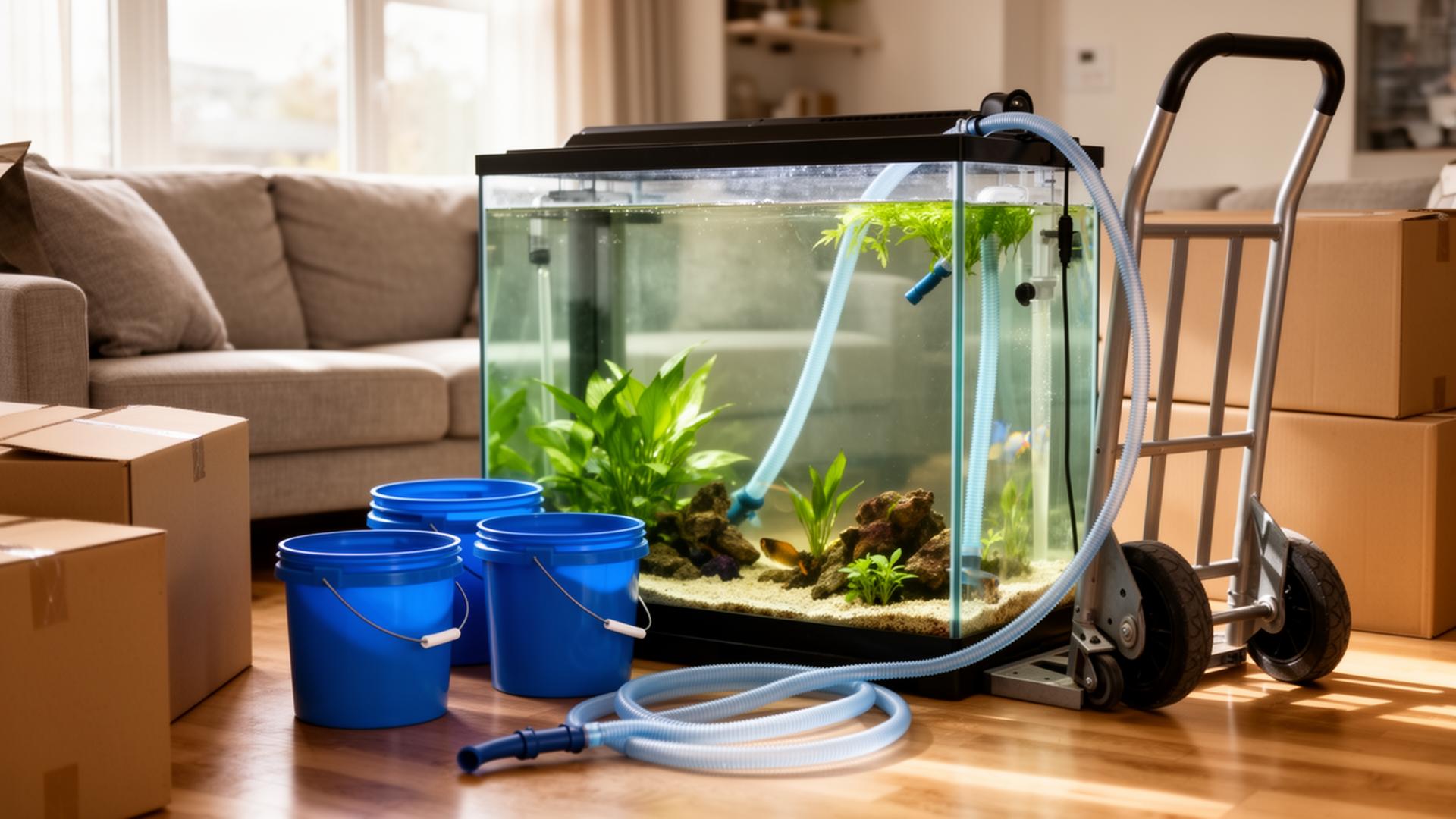

How to Move a Large Fish Tank Without Losing a Single Fish
Moving across town is stressful enough. Moving across town with a 75-gallon planted tank, a cycled biological filter, and a half-dozen fish who have no idea what is happening makes "stressful" sound generous. A large aquarium is heavy, fragile, alive, and unforgiving of shortcuts. Done right, the move is a long but uneventful day. Done wrong, it ends with cracked silicone, a crashed nitrogen cycle, and fish that do not make it through the week.
This guide is the playbook we wish someone had handed us the first time. It works for freshwater and saltwater, for community tanks and single-species setups, and it scales from a 40-gallon breeder up to a 125-gallon reef.
Start two weeks out, not the night before
The single biggest mistake is treating the tank like furniture you can wrap on move day. Almost everything that goes wrong with a fish move can be prevented by decisions you make one to two weeks in advance.
Two weeks out:
- Stop adding new livestock or plants. You do not want anything brand new in the system when you stress it.
- Do a normal water change and a light gravel vacuum. Do not deep clean. You want your beneficial bacteria thriving, not disturbed.
- Buy or borrow what you need: clean five-gallon buckets with lids, a battery-powered air pump and airstones, fish-safe transport bags or insulated coolers, a long siphon, towels, a moving dolly rated for the tank's full empty weight, and a roll of painter's tape.
- Photograph the tank from every angle. You will use these photos to put your aquascape back exactly where it was, which matters more than you would think for territorial fish.
One week out:
- Test your water and write down the readings. You want a clean baseline so you can spot trouble in the new home before it becomes a crisis.
- Skip the weekly water change this time. The water in the tank right now is the water your fish are healthiest in. You will be reusing as much of it as possible.
- Reduce feeding to about half the normal amount. A lightly fed fish produces less waste in transport bags and handles the trip with less stress.
The day before:
- Do not feed at all. Fish can comfortably skip a day, and an empty gut means cleaner transport water.
- Unplug the heater so it has time to cool. Glass heaters that move from warm water into open air can shatter when re-submerged hot.
- Charge the battery air pump and pack a spare set of batteries.
Plan the route before you plan the day
For anything over about 40 gallons, the tank does not ride in the moving truck. It rides in the back of your own vehicle, padded with blankets, ideally on its side or upright but never face-down. Movers are wonderful humans, but they are not insured for a 200-pound glass box full of memories.
Map the drive. If the new place is more than a couple of hours away, plan a midpoint where you can check the fish, add an airstone, and top off temperature if it is cold or very hot outside. In the USA, summer asphalt can push a closed car interior past 120F in under an hour, and most tropical fish start suffering at 86F. Run the AC on move day even if it costs you a little efficiency.
Move day, in order
The order matters. If you pull the tank before you have somewhere to put the fish and the water, you will improvise, and improvising with livestock is how losses happen.
1. Bag or bucket the fish first
Catch fish gently with a soft net and move them into transport containers filled with their own tank water. Rules of thumb:
- One adult fish per bag for anything aggressive, spiny, or larger than three inches. Doubling up saves bags and costs fish.
- Fill bags about one third water, two thirds air. For trips over an hour, ask a local fish store to bag with pure oxygen if they will.
- For tanks with many small fish, a clean five-gallon bucket with a lid and a battery air pump is faster and safer than dozens of bags.
- Keep buckets and bags in a cooler or insulated tote in the dark. Dark plus quiet equals calm.
Inverts, corals, and any saltwater livestock get their own containers. Do not mix species you would not normally house together, even for an hour.
2. Save the water and the filter media
Beneficial bacteria live almost entirely on surfaces, not free-floating in the water column. That said, you want as much of the existing water as you can reasonably carry, because it is already chemically dialed in for your fish.
- Siphon at least half the tank volume into clean buckets with lids. More is better if your vehicle can take the weight. A gallon of water weighs about 8.3 pounds, so a five-gallon bucket lands near 42 pounds full.
- Pull the filter media (sponges, ceramic rings, bio balls) and place them in a sealed bucket of tank water. They must stay wet the entire move. Dry media equals a dead bacterial colony and a tank that has to cycle from scratch.
- If you run a canister filter, do not drain it. Cap both hoses and move it upright. The water and bacteria inside are doing real work.
3. Remove decor, plants, and substrate
Hardscape goes into a bucket with tank water so it stays wet and keeps its own bacterial film. Live plants ride in sealed bags or a wet bucket. Substrate is the one judgment call:
- For sand: leave a thin layer in the bottom of the tank if the tank is small enough to move with that weight. Otherwise, scoop it into buckets.
- For gravel under three inches deep: scoop it into buckets and rinse very lightly in old tank water, never tap.
- For deep planted substrates with root tabs: leave as much in place as possible. Disturbing it releases trapped gases you do not want your fish breathing later.
4. Move the empty tank
A "large" tank means anything over about 40 gallons or anything wider than a standard doorway. Empty, a 75-gallon tank still weighs roughly 140 pounds. Treat it like a sheet of glass that bites back.
- Two people minimum, four for anything 90 gallons and up.
- Lift from the bottom frame, never from the top trim. The top is decorative. The bottom carries the load.
- Use a furniture dolly with straps, and keep the tank upright. Tipping a tank flexes the silicone seams in ways they were never designed for, and seams can fail days or weeks later.
- Pad the stand separately. Many tank failures come from a stand that got dinged in transit and no longer sits flat.
5. Reassemble in the new home before unpacking anything else
Set the stand, level it with a small bubble level in both directions, place the tank, replace substrate, add hardscape using your photos as reference, and refill with the saved water first. Then top off with fresh, dechlorinated tap water matched to within two degrees of the saved water temperature.
Reinstall filter media wet, plug the filter and heater back in, and let everything run for at least 30 minutes before adding fish. Watch for leaks at every seam and at every hose connection.
Acclimate the fish to the refilled tank the same way you would acclimate a new fish from a store: float the bags for 15 minutes, then drip or cup-swap small amounts of tank water in over another 20 to 30 minutes. Even though it is "their" water, the trip has changed temperature and oxygen levels enough to matter.
What to pack: the short list
- Clean five-gallon buckets with lids, one per 10 to 15 gallons of tank volume
- Battery-powered air pump, extra batteries, and two airstones
- Soft fish net in two sizes
- Long siphon hose and a shorter python-style hose for refill
- Transport bags or insulated coolers for livestock
- Painter's tape and a marker for labeling bucket contents
- Bath towels for spills and padding
- Water conditioner, test kit, and a thermometer you trust
- Your written baseline water readings from last week
When to call in help, and when to call the vet
A few situations call for backup. If your tank is a reef with established corals, hire a local aquarium service for the move or at least for the breakdown and rebuild. Coral losses can dwarf the cost of a professional. If you are moving more than a few hours away, talk to a fish-experienced veterinarian before you go, especially for koi, large cichlids, or any species on a medication schedule. Aquatic vets are rarer than dog and cat vets in the USA, but they exist, and a 10-minute phone consult before the move is worth it.
Watch the tank closely for the first two weeks in the new home. Test ammonia and nitrite every other day. If either climbs above zero, do small, frequent water changes and feed lightly. A mini-cycle is normal after any move that disturbs substrate, and it is manageable if you are paying attention. Fish that hide for a day or two after the move are not a crisis. Fish that gasp at the surface, clamp their fins, or refuse food for more than three days are. When in doubt, call your aquatic vet.
A large tank move is not a project you win by going fast. You win it by going in order, keeping the right things wet, and giving your fish the boring, predictable trip they cannot ask for themselves.
Enjoying this post?
Get the next one sent straight to your inbox — no spam, unsubscribe anytime.